

Innovation A Hot Topic At RB Forum
Updated: October 2, 2015 at 2:09 pm
By Kelsey Riley
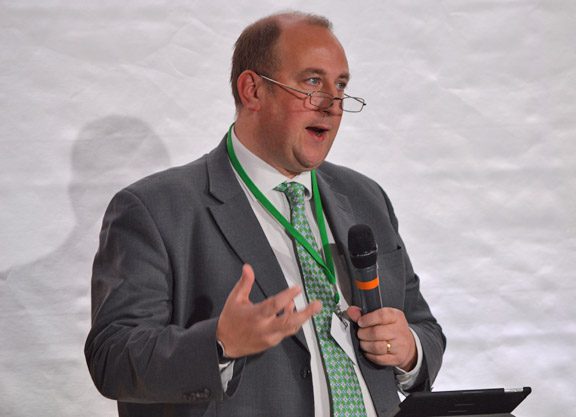
Innovation was the key theme at the eighth annual Racing and Betting Forum in Paris, France, Friday on the eve of Prix de l’Arc de Triomphe weekend, when 160 senior managers and executives–both from within racing and without–from 27 countries gathered to discuss how the horse racing industry can innovate digitally, socially and commercially.
Keynote speakers were Per Sundin, vice president of Universal Music, Nordic Region; and Nick Rust, chief executive of the British Horseracing Authority. Sundin kicked off proceedings by discussing how innovation in the music industry has been key since the turn of the century. Sundin explained that when the music industry in Sweden found its revenue slashed in half between 2000 and 2008 due to the rising popularity of online sales and streaming services, it was a “disrupt or die” situation. Universal made what was seen as a radical move in 2008 by kickstarting Spotify, an online music, podcast and video streaming service that has grown since 2008 to accommodate more than 75 million users.
Fast-forward to the present day, and Sweden is the highest-grossing country in digital income in the world, with 82% of total music revenue in Sweden coming via streaming.
Sundin, a racehorse owner in Sweden for 25 years, stressed the importance of being open to change and focusing on consumer needs.
“Everything is changing, and we need to think, what do the consumers want?” he said. Sundin signed off by stressing “there is no room for complacency,” and added, “Everything is going mobile, and this is what you have to embrace. No one knows what is happening now–we are all kids, and you can decide what type of kid you want to be. You have a choice today; you’re not too old or fixed in your habits. You can do change–change is fun.”
Rust then took the podium to discuss what practices are being put into action to innovate racing as a sport and a business. The first problem he addressed was the well-documented issue of British racing’s broken Levy system.
“The funding issue that we have–and the connection with the key parts of our environment, the betting customer–is not strong,” Rust noted. “The Levy has created a situation of need and dependancy and demand, rather than of innovation and cooperation. It gets in the way of innovation and good commercial relationships.”
Rust stressed the importance of British racing being proactive and building on its current systems to achieve a desired outcome.
“In my opinion, the secret to closing the gap in providing innovation in betting, consumer activity and funding for British racing is not to pine for a system that other countries have in place, but rather to embrace the consumer realities, build trust and work with the betting industry and consumers to create conditions of growth in betting on British racing alongside of a sustainable funding mechanism,” he said. “Gone are the days when British racing can sit back and demand more from betting operators on moral grounds alone.”
So how does the British industry go about building trust and capitalizing on growth opportunities? Rust pointed to the media rights agreement announced last week between Racecourse Media Group and Satellite Information Services that will create a more efficient link between RMG and bookmakers.
Rust pointed out that racing and betting operators need to be open to failures along the road to innovation and success.
He added, “In many ways, racing is the perfect product for the digital age. It’s a fascinating puzzle to the more analytical viewers and a pure adrenaline rush.”
Rust concluded by outlining some of the measures the BHA is working on to improve British racing, including exploring the potential of more racing on evenings and Sundays; and working with Ireland to harmonize race times and also working to alleviate race clashes domestically–a 2% levy increase was seen last year after this initiative was started. In addition, a BHA innovation group is looking at major opportunities for media coverage, fixture list improvements and sectional timing.
Rust also opined that more information needs to be available to bettors.
“We don’t tell our consumers everything at the moment, and one of the most annoying things for bettors is when they see a horse improve by 13 lengths and the winning trainer appears live on TV and says, ‘I’m absolutely delighted, what’s the secret to it, I’ve given the horse a wind operation since its last run.’ This sort of information undermines confidence in consumers and it’s a thing of the dark ages. Some horsemen believe that information is special to them and should be retained; I believe it puts the sport in the backwater. We need to reveal more information.”
The keynote speakers were followed by a panel discussion entitled “how to work on innovation,” with the first panel comprised of non-racing executives, and the other made up of executives from within racing.
Anne Lalou of Web School Factory shared the story of how her company trains young executives to be effective thinkers in the modern world.
“In a very rapidly changing world, if you don’t understand anything about tech, design, or e-management, you won’t be tomorrow’s manager,” she said. “All my students are digital natives; they have a completely digital native view on how things should be. We have one obsession, which is digital innovation.”
Vincent Boon, whose company Standing On Giants helps other companies communicate with their customers by developing online platforms, explained that his company implements and tests every three days an idea supplied by a customer.
“It is important to have a customer-centric approach and put communities at the heart of your product,” he said.
The racing executives panel was comprised of Rust, Guillaume Dolbeau of PMU; Bernard Marantelli of ColossusBet; Ed Comins of Watch & Wager and Mikael Kudren of ATG.
Rust touched on how can racing as a sport ensure it continues to be relevant as customer demands, social environments, and expectations evolve.
“We have to make [betting] more relevant in the digital world,” Rust said. “We’re looking at how we create sectional timing, horse tracking, the ability to use technology to display, analyze and provide real-time access to racing, all of which is designed to open it up and make it more interesting.”
“Horse racing is a sport of personality; of people and heroes, and we need to give access into their world,” he added. “We just need to open it up and make the human and equine side more accessible, then plug that into the betting side. I’m not going to suggest we’re going to change the rules so that 10th place is being fought over between two jockeys because there’s match betting all the way down, but the rules of racing are open to change to facilitate improvements in betting.”
Comins touched on the American model of innovation through his experience with Watch & Wager.
“When we moved our business to San Francisco four years ago, everyone said, ‘you’re completely mad–you’ll get eaten up by Churchill Downs and TVG,’” he said. “We did have to look at it in a different way, and the first thing we did was acquire Cal Expo in San Francisco and we’ve been running that for 3 1/2 years very successfully.”
Comins noted that stricter regulations in the U.S. means one must be more creative to innovate.
“Sometimes it’s more commercial innovation; you have to think on your feet and do a deal to grandfather you in for another deal.”
Comins touched on the fact that Watch & Wager is the first company to commingle into Hong Kong betting pools.
“We’ve had to innovate there in terms in the number of tracks we’re covering around the world, but also most importantly the speed of processing of wagers. The U.S. is a tricky place, but we’ve been very flexible and tripled our turnover this year.”
Upon the conclusion of the panel, attention turned to the first session of individual speakers, with Benoit Fabrega and Emmanuel Roussel beginning the “Faster Digitally” session with an explanation of Le TROT’s new app, Hipodrome Connecte. The app, which has been downloaded more than 6000 times, is now available at three French racecourses–Vincennes, Cabourg and Enghien–and focuses on a simple, user-friendly interface.
“Customers need new tools to get ahold of information at the right time, and the digital age helps provide support to those customers,” said Fabrega.
In addition to having past performance features and dynamic race replay options, Hipodrome Connecte has a unique ‘social odds’ feature: with the click of a ‘like’ button, racegoers can share their selections with others on the network, and a separate set of odds is reflected. Fabrega explained this feature was designed to combat new fans’ initial fears of putting their money down.
“New racegoers were concerned about putting their money on a horse, so we thought, maybe we can help them by giving them the opportunity to bet for free, and boost their confidence,” he said. “You earn points for winning bets, which can be exchanged towards a betting voucher. The top social bettor of the day gets a €50 on-course betting voucher. You can also follow other social bettors and get their selections.”
Keith Brackpool of the Stronach Group carried on the session by explaining how the U.S. racetrack revenue model differs from those in Europe.
“The vast majority of our income is based on the handle as opposed to ticket sales, the food and beverage revenue, or whatever else you see at some of the larger festivals in Europe,” he said. “On-track handle is worth twice as much to us as any wager that comes from another place. So whilst we encourage wagers from everywhere, actually getting people at the track to bet is the most important thing.”
Brackpool described the $40 million makeover of Santa Anita Park to make it more friendly to a younger crowd, and stressed the importance of video content in the track’s digital marketing plan for getting patrons to the races. He talked about the track’s aggressive social media strategies from morning training all the way through the races, where they put a focus on getting celebrities to the track and sharing their experiences digitally.
The afternoon session kicked off with the “Better Socially” section of the conference. Vincent Boon took to the podium again to discuss how his company, Standing On Giants, helps other businesses turn customers into ambassadors through the development of online communities. Boon noted, “we empower customers, thus reducing business costs,” a point that was reiterated by Chloe Beauvallet, client services manager of PMU, who explained how PMU has revolutionized its customer service approach. The company has used digital platforms, including social media, to ensure “customers are never alone if they have a problem.”
Maria Sandell, the chief executive officer and co-founder of Genera Networks, discussed how she relies on a combination of simplicity, entertainment, distribution and revenue potential to develop innovative lottery games including Nabor, which is currently active in Finland and Norway and is expected to generate a revenue of €40 million this year.
The conference’s third session was entitled “Stronger Commercially” and Rod Kholer, managing director of Revolution Sports + Entertainment, provided an overview of the changing face of sports sponsorships. Kohler explained that in addition to signing onto longer deals–five to 10 years–than was previously the norm, brands have expectations of working actively with a sport to drive promotion, while at the same time the sport often now expects the brand to take a proactive approach.
A difference between sponsorship in racing and other sports, Kohler explained, is that racing sponsorships are dominated by companies with a vested interest in the sport. Also, unlike other sports, sponsorship in racing in the UK is often tied to the sport’s lifeblood: prize money.
Kohler described varying sponsors for individual races on a single day as a “clutter.”
“There has to be a way we can move away from this ‘one race, one sponsor’ model,” he said, suggesting it would be a better experience for sponsors to have great exclusivity and more space.
“That sort of approach and mindset is what’s going on in other sports in the sponsorship sector–why shouldn’t it happen in racing?” he said.